Mapping Network Topology Effects on Simultaneous Multi-Region Cooperative Game Broadcasts
Tina Schmitt · Aug 1, 2026
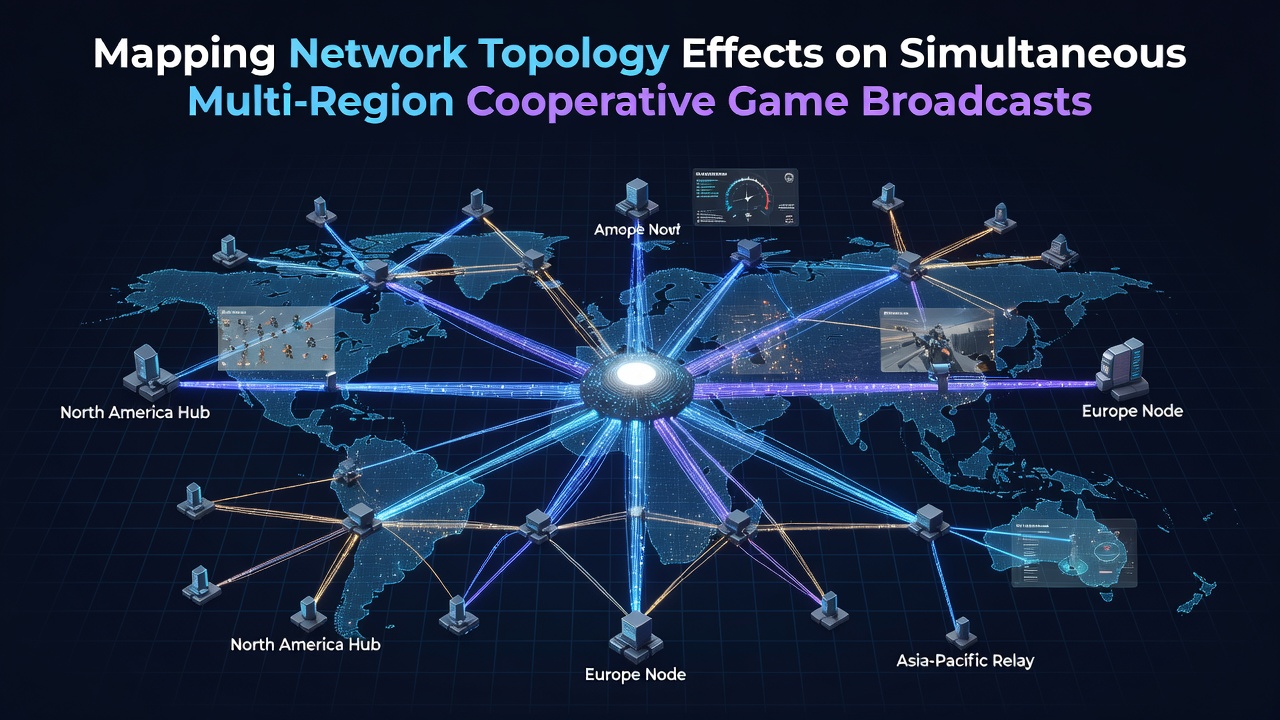
Mapping Network Topology Effects on Simultaneous Multi-Region Cooperative Game Broadcasts
Network topology mapping has become central to managing simultaneous multi-region cooperative game broadcasts where players coordinate across continents in real time. Different structures such as star, mesh, and hybrid configurations determine how data packets travel between servers, clients, and broadcast relays, and researchers track these paths to measure impacts on latency, jitter, and synchronization.
Core Topologies and Their Operational Profiles
Star topologies route traffic through central hubs, which simplifies monitoring yet creates single points of congestion when multiple regions feed streams simultaneously. Mesh arrangements distribute load across peer connections, allowing alternative routes during peak demand, while tree structures layer regional nodes under backbone exchanges to balance cost and reach. Observers note that each pattern produces distinct delay signatures when broadcasts involve four or more time zones at once.
Data from infrastructure studies shows star setups often register baseline latencies of 45 to 65 milliseconds between North American and European nodes, whereas mesh overlays can trim that range by rerouting around saturated links. Hybrid models combine both approaches and appear frequently in large-scale cooperative titles where regional clusters must remain phase-aligned during shared events.
Latency and Synchronization Patterns Across Regions
Simultaneous broadcasts require sub-frame alignment so that cooperative actions register consistently for all participants and viewers. When topology maps reveal high-diameter paths, cumulative packet serialization delays compound, and synchronization protocols must compensate with predictive buffering. In August 2026, several major titles implemented dynamic topology probes that adjust relay selection every 30 seconds based on live traceroute data.
Studies conducted by academic teams at the University of Melbourne and the Canadian National Research Council indicate that tree topologies with regional aggregation points reduce cross-Pacific jitter by approximately 18 percent compared with flat star designs. Those same reports document that mesh networks maintain tighter synchronization windows during sudden traffic spikes caused by in-game events that draw viewers from Asia, Europe, and the Americas within the same minute.
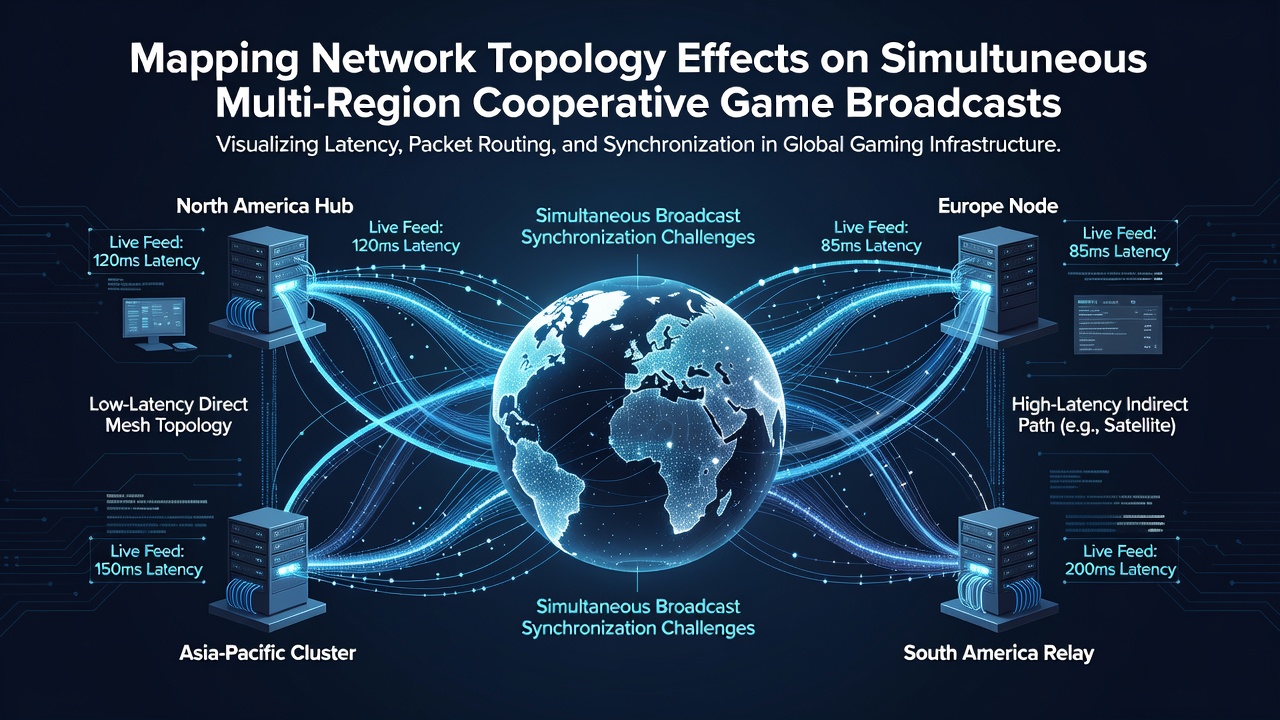
Bandwidth Allocation and Congestion Mapping
Bandwidth allocation under different topologies influences both stream quality and viewer retention metrics. Star hubs concentrate upstream demand, which forces operators to provision larger pipes at central exchanges, while distributed mesh nodes spread the load and allow incremental capacity additions. Mapping tools now overlay real-time utilization graphs onto topology diagrams so broadcast engineers can identify emerging bottlenecks before they affect cooperative timing.
Figures released by the European Commission's connectivity unit reveal that hybrid topologies handling 4K cooperative streams across five regions consume 12 to 15 percent less peak bandwidth than equivalent star deployments. The same dataset shows that mesh configurations experience fewer retransmission events when regional fiber cuts occur, because alternate paths activate within 200 milliseconds.
Measurement Frameworks and Recent Deployments
Operators rely on active probing, passive flow analysis, and synthetic traffic generators to build accurate topology maps. These frameworks assign cost weights to each link based on measured round-trip times, loss rates, and available capacity. In practice, teams integrate these maps into orchestration systems that select broadcast paths for each cooperative session.
According to an NIST analysis of distributed gaming environments, topology-aware routing reduced observable desync events by 27 percent across tested multi-region scenarios during 2025 trials. A separate report from Australia's CSIRO digital networks group reached similar conclusions when evaluating mesh overlays for cooperative survival titles that run extended sessions across Oceania and North America.
Practical Adjustments in Live Environments
Broadcast teams apply topology maps during pre-event planning and during live adjustments. They pre-position relay servers at high-degree nodes identified in the maps, then shift traffic when congestion thresholds are crossed. This approach supports the simultaneous delivery of multiple regional viewpoints without introducing additional encoding latency.
Cooperative titles that schedule cross-region raids or joint objectives now incorporate automated topology updates into their server fleets. The updates rely on continuous mapping data rather than static configurations, allowing the system to maintain frame-level alignment even when one region experiences transient routing changes.
Conclusion
Mapping network topology effects supplies the factual foundation for stable simultaneous multi-region cooperative game broadcasts. By quantifying latency distributions, synchronization margins, and bandwidth demands under star, mesh, and hybrid structures, operators can select and adjust paths that keep cooperative actions aligned for participants and viewers alike. Ongoing data collection through 2026 continues to refine these models as new fiber routes and peering agreements come online.