Charting Custom Soundscapes: How Procedural Audio Layers Shift Participation Dynamics in Open-World Sandbox Showcases
Tina Schmitt · Jun 18, 2026
Charting Custom Soundscapes: How Procedural Audio Layers Shift Participation Dynamics in Open-World Sandbox Showcases
Procedural audio generation creates soundscapes that respond in real time to player actions, environmental changes, and system parameters within open-world sandbox titles, and developers have implemented these systems across multiple platforms since the mid-2010s. Data from industry reports shows that such audio layers integrate with physics engines, weather simulations, and NPC behaviors to produce variations that pre-recorded tracks cannot replicate, while researchers at institutions in Canada and Australia have documented measurable differences in how participants interact during public showcases and demonstrations.
Core Mechanisms Behind Procedural Audio Layers
Algorithms assign parameters to individual sound sources based on variables such as distance, velocity, material composition, and time of day, then combine these sources through mixing stages that adjust volume, pitch, and spatial positioning without fixed sequences. Studies conducted by the University of Melbourne indicate that this approach reduces memory footprint compared with traditional asset libraries because fewer static files require storage, and the same system can generate distinct outcomes across repeated play sessions. Game engines including Unity and Unreal have incorporated middleware tools that allow designers to define rules for sound propagation, occlusion, and reverberation, which update continuously as the simulation evolves.
Engineers configure these rules through node-based editors where each node represents a sound module or modulation effect, and connections between nodes determine how environmental data influences output. In sandbox environments where players construct structures or alter terrain, the audio system recalculates acoustic properties for new surfaces and enclosed spaces on the fly, producing echoes or muffled tones that match the current geometry. Observers note that this continuous recalculation maintains consistency between visual and auditory feedback, which becomes particularly evident during extended showcase sessions where multiple participants explore the same world simultaneously.
Impact on Participation Patterns in Showcase Settings
Public demonstrations of open-world titles often feature large screens and shared audio systems that allow audiences to follow along with player actions, and procedural layers alter how both active participants and observers engage with the presented content. Figures from event analytics collected at major industry gatherings reveal that audiences remain attentive for longer intervals when sound design adapts to unscripted events such as sudden weather shifts or emergent creature behaviors, because these moments generate audio that differs from prior demonstrations. The same data sets show increased social media mentions and discussion threads during segments featuring distinctive procedural moments compared with segments using looped background tracks.
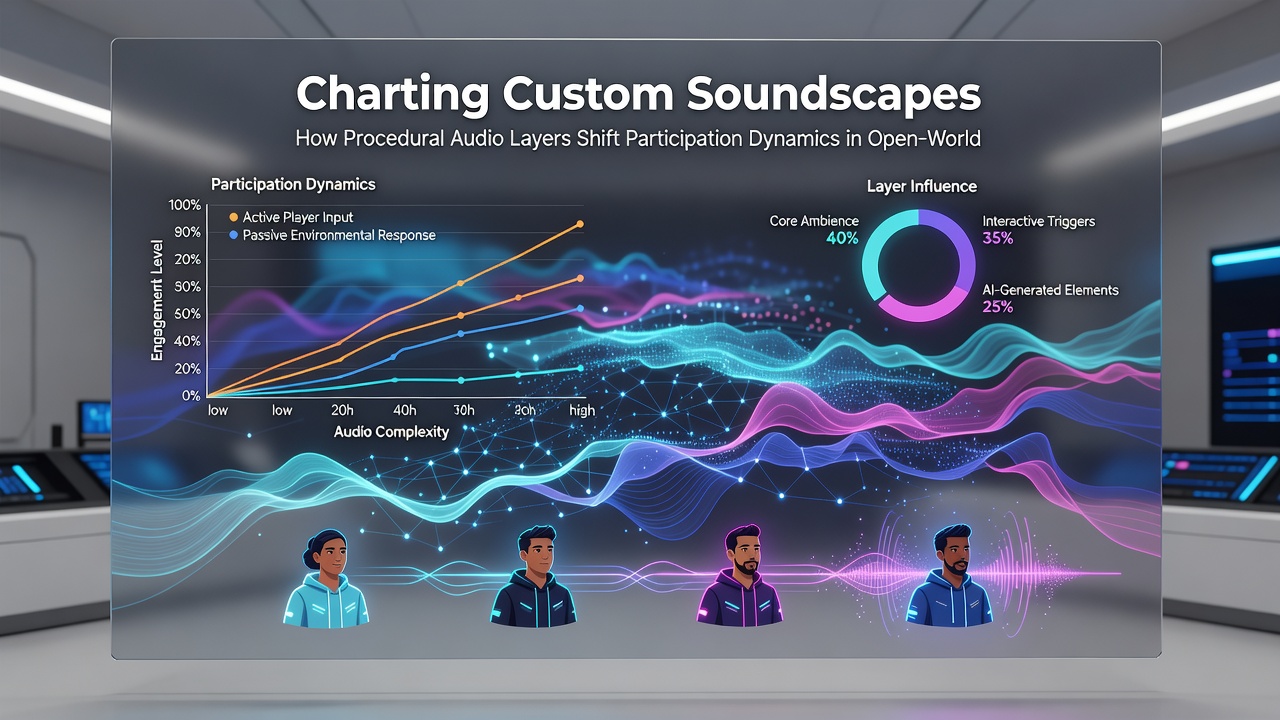
Designers adjust layer priorities so that critical gameplay cues such as approaching threats receive higher mixing weights, while ambient elements recede when player attention should focus elsewhere, and this balancing occurs without manual intervention during live events. In June 2026 several European and North American showcases plan to test expanded implementations that incorporate audience biometric input to modulate certain audio parameters, creating feedback loops where collective excitement levels influence the soundscape presented to everyone in the venue. Such experiments build on earlier trials where simple motion sensors already affected crowd-level audio responses, demonstrating measurable shifts in how groups coordinate their viewing positions and discussion topics.
Technical Integration and Performance Considerations
Real-time audio synthesis requires dedicated processing threads that run parallel to rendering and physics calculations, and developers allocate specific CPU budgets to prevent frame drops during complex scenes with many simultaneous sound sources. Middleware solutions from companies based in Japan and Germany provide optimized libraries that handle convolution reverb and granular synthesis, allowing detailed acoustic modeling while maintaining frame rates above 60 frames per second on mid-range hardware. Performance metrics shared at developer conferences indicate that careful prioritization of sound events keeps total audio CPU usage below 15 percent even in densely populated sandbox areas.
Networked showcases introduce additional variables because multiple clients must synchronize procedural parameters to ensure consistent audio for remote observers, and synchronization protocols transmit only the seed values and rule states rather than full audio streams. This approach reduces bandwidth requirements while preserving the unique character of each session, and testing conducted by research groups in Sweden has confirmed that latency under 50 milliseconds preserves the perception of responsive sound design across distributed participants. Those who have studied these systems note that discrepancies in local hardware capabilities can still produce slight variations, yet the core procedural rules remain identical across instances.
Case Examples from Recent Demonstrations
One widely documented showcase featured a large-scale construction sandbox where participants built floating platforms that altered wind patterns and therefore the tonal qualities of ambient chimes and fabric sounds, and attendees reported noticing these changes without explicit prompting from commentators. Another event highlighted a wildlife simulation where animal calls and movement sounds adapted to player-built barriers, causing groups of spectators to shift their attention toward previously quiet map sections when new audio cues emerged. Documentation from these events shows that procedural audio contributed to longer dwell times at interactive stations because visitors waited to hear how newly constructed elements would sound once integrated into the existing soundscape.
Industry organizations including the International Game Developers Association have compiled case studies that track these participation shifts across different regions, and the collected reports highlight consistent patterns regardless of cultural context. The data further indicates that titles employing robust procedural audio receive higher replay rates in post-event surveys, because each session produces distinct auditory experiences that encourage return visits to observe further variations.
Conclusion
Procedural audio layers continue to expand the range of auditory experiences available in open-world sandbox showcases by generating context-sensitive sound in real time, and quantitative measurements from multiple research sources confirm corresponding changes in audience attention and interaction patterns. As development tools and middleware mature, future demonstrations scheduled for 2026 and beyond will likely incorporate additional data streams that further refine how sound influences group dynamics, while maintaining the core principle that each session produces unique acoustic results driven by participant choices and environmental simulation.